
A new paper released in May 2026 has reignited the debate on the future of autonomous driving safety. The document, published on the pre-print server arXiv, details a method using generative data augmentation to help AI models learn from rare accident scenarios they haven’t physically encountered. The promise is a groundbreaking leap in predictive safety.
Table of Contents
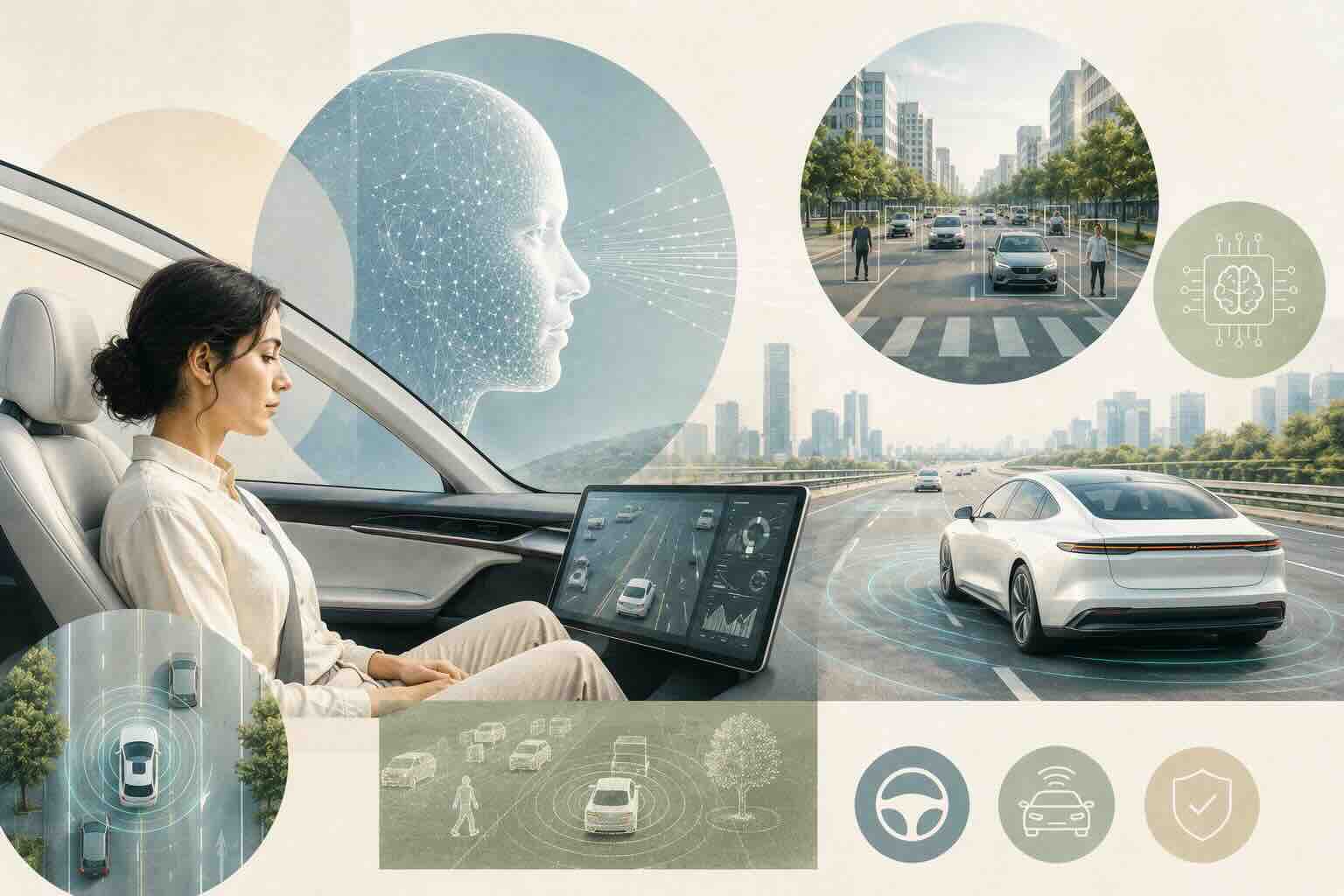
However, our investigation reveals a considerably complex reality. While generative AI offers a tantalizing solution to the data scarcity problem for edge-case accidents, it also introduces alarming risks of its own, including model “hallucinations” and a potential disconnect from real-world physics. This puts the promise of enhanced the technology on a collision course with the unforgiving laws of the road
The 2026 Landscape of Predictive Safety
The this innovation sector is currently a battleground for a handful of tech giants. The two most prominent approaches are championed by Waymo (owned by Alphabet) and Tesla. Waymo’s strategy is built on a foundation of high-definition mapping and a multi-sensor suite including LiDAR, which provides precise distance measurements. This leads to a cautious, data-driven methodology that has resulted in a lower rate of fatal incidents, though it is often criticized for its limited operational domains and sometimes overly conservative driving behavior.
In stark contrast, Tesla’s approach relies primarily on vision-based systems. The company’s “Full Self-Driving” (FSD) system uses cameras to interpret the world, arguing this is closer to how humans drive. This method allows for faster, broader deployment, but it has faced intense scrutiny over its safety claims and a significantly higher number of reported fatalities compared to Waymo. Recent reports from May 2026 even feature former AI trainers at Tesla expressing a lack of trust in the system’s capabilities.
A number of other automotive players are also in the race. General Motors, for instance, patented a system in early 2026 that uses head-up displays to warn drivers of non-line-of-sight collision risks. This highlights a broader industry trend: enhancing driver assistance with predictive alerts rather than aiming for full autonomy immediately. The entire industry is moving toward more proactive, AI-driven safety systems, a trend that will be accelerated by mandates like Europe’s Advanced Driver Distraction Warning (ADDW) systems required by July 2026. This makes the accuracy of the system more critical than ever.
Read also: Musician hand: The Breakthrough Redefining Robotic Learning
Deconstructing the Hype Around Synthetic Data
The fundamental premise of the paper is to use AI-generated data to train for uncommon accidents. Autonomous systems are trained on massive datasets, but real-world data on freak accidents—like a tire detaching from a truck at high speed—is very scarce. The paper suggests creating synthetic video data of these rare events to train the it model. The idea is to give the AI experience without the real-world risk.
There are substantial dangers associated with this technique. A key problem with generative models is their tendency to “hallucinate”—that is, to create outputs that are plausible but factually incorrect or physically impossible. An AI trained on synthetic data might learn from a scenario with flawed physics, leading to unpredictable behavior in the real world. The consequences of such errors are far greater when a model is controlling a two-ton vehicle.
The ongoing conflict between different sensor philosophies also impacts the platform. Waymo’s LiDAR-heavy approach provides robust geometric data, which could serve as a “ground truth” to validate synthetic scenarios. Tesla’s vision-only system, however, lacks this redundant, precise measurement, making it potentially more vulnerable to being misled by flawed synthetic data. Critics of Tesla’s safety statistics argue the company already uses misleading comparisons to overstate its system’s safety. Injecting hallucinated training data into such a system could amplify existing safety concerns.
The Regulatory Friction and Ethical Quagmire
There is a growing gap between AI innovation and government oversight. As of early 2026, the National Highway Traffic Safety Administration (NHTSA) is still in the process of reviewing how its Federal Motor Vehicle Safety Standards apply to automated driving systems. This lack of clear guidance means developers are working in a gray area, allowing companies to deploy systems with varying, and sometimes opaque, safety validation methods.
On top of regulatory issues, there are profound moral challenges. The classic “trolley problem” is no longer a philosophical thought experiment; it’s an engineering challenge for the technology systems. Researchers at institutions like Stanford University have highlighted that these systems must be programmed to make choices in unavoidable crash scenarios. Does the algorithm protect the owner of the car at all costs, or does it make a utilitarian calculation?. The use of generative data for this innovation adds another layer of complexity: if the AI’s decision is based on a “hallucinated” scenario, who is liable?
Some experts argue that the entire premise of programming for such dilemmas is flawed. Chris Gerdes at Stanford’s Center for Automotive Research suggests that AVs should simply be held to the existing social contract embedded in our traffic laws. Not everyone in the autonomous driving space agrees, with some developers aiming for “naturalistic” driving that might include breaking minor traffic laws, just as humans do. This fundamental disagreement on ethics and rules of the road creates a dangerous environment for deploying predictive technologies like the system.
The Bottom Line on autonomous driving safety
In conclusion, the promise of using generative AI to enhance it is a double-edged sword. The arXiv paper points to a theoretically powerful tool for training models on rare events, but it glosses over the critical dangers of model hallucination and the lack of real-world grounding. When applied to a physical system like a car, where errors have fatal consequences, these are not trivial concerns.
The technology does not exist in a vacuum. The aggressive, vision-only strategy of Tesla, combined with its controversial safety reporting, creates a risky testbed for such unproven methods. Waymo’s more cautious, multi-sensor approach seems better positioned to validate synthetic data, but its slower rollout means its impact on road safety is more limited. For now, the platform remains a powerful but deeply flawed tool.
Critical Signals to Watch:
* Monitor: The first instance of a major OEM publicly announcing the use of generative data augmentation in its production safety models.
* Watch for: Any new proposed rules from the NHTSA that specifically address the validation and safety of AI models trained on synthetic data.
* Key signal: Peer-reviewed studies that either validate or debunk the safety benefits of generative autonomous driving safety using controlled, physical tests, not just simulations.
* Track: The ongoing debate between vision-only and LiDAR-inclusive systems, as the outcome will heavily influence how technologies like generative autonomous driving safety are implemented.
* Observe: Changes in insurance liability models for accidents involving Level 3+ autonomous systems, which will indicate who the industry truly holds responsible.
For the foreseeable future, the pursuit of reliable autonomous driving safety will remain one of the most contentious and high-stakes endeavors in technology. The safety of our roads depends on getting it right.